- Home
- Residents
- Virginia Cooperative Extension
- Annual Report
Annual Report | Fiscal Year 2025
Research-based education powering resilient communities
Executive Summary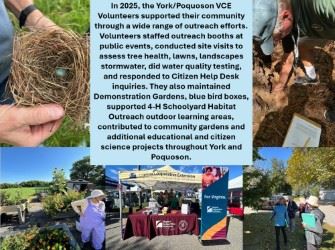
Virginia Cooperative Extension (VCE) connects York County and Poquoson residents to university-backed education that solves real problems in homes, schools, neighborhoods, and natural areas. In 2025, our volunteers and partners expanded access to horticulture, natural resources, and 4‑H youth development programs—delivering hands-on learning, improving environmental stewardship, and building local leadership.
- 321 trained volunteers powered our work with more than 24,000 hours of service—valued at $856,565—and invested 2,827 additional hours in training.
- Nearly 87,000 educational contacts advanced community knowledge in gardening, water quality, wildlife habitat, and citizen science.
- Over 2,000 youth engaged through 4‑H with camps, school enrichment, and clubs; our summer residential camp served 140 campers supported by 16 trained teen counselors and 12 trained adult volunteers.
- Equity and access advanced through hybrid training, virtual help services, accessible gardens and signage, and targeted programs in historically underserved communities.
2025 By the Numbers
Metric | Result |
Total Volunteers | 321 |
Volunteer Service Hours | 24,621 (plus 2,827 training hours) |
Estimated Community Value of Service | $856,565 |
Educational Contacts (All Programs) | 86,934 |
Master Gardeners | 150 volunteers; 10,508 hours; 19,815 contacts |
Virginia Master Naturalists | 138 volunteers; 10,713 hours; 67,119 contacts |
4‑H Youth Development | ≈2,600 volunteer hours; 5 adult club leaders; 140 campers; 16 teen counselors; 12 adult camp volunteers |
Community Investment | +$36,000 raised via plant sales, donations, and fees for horticulture/naturalist programs; office received $1,023 in monetary & in‑kind donations; MG $550 in donations; VMN $4,455 in grants |
Environmental Stewardship Highlights | 5,088 lbs litter removed; 37,000+ lbs plastic recycled (8 years) |
Who We Are
York/Poquoson VCE links Virginia Tech and Virginia State University expertise with local priorities. Our educators, staff, and volunteers deliver evidence‑based programs in agriculture including commercial and consumer horticulture, natural resources, and 4‑H youth development. We convene partners across county departments, schools, community organizations, and regional networks to multiply impact.
Key partners include:
- York County: Community Services, Parks & Recreation, Public Works, Tourism, Mosquito Control
- City of Poquoson: Parks & Recreation, Poquoson History Museum
- University & State Partners: Virginia Tech specialists and the Hampton Roads AREC; Virginia State University (VSU) Randolph Farm
- Civic & Community Partners: Colonial SWCD; DEQ; Bluebird Gap Farm; Old Dominion University; local libraries; schools
What We Do
Master Gardeners & ANR Agent- Agriculture: Horticulture & Natural Resources
Master Gardeners (MG) provide research‑based education through classes, library talks, outreach booths, and the Horticulture Help Desk to York County and the City of Poquoson. Volunteers maintain two demonstration gardens that showcase sustainable practices and pollinator habitat, and they support two community gardens that increase access to fresh food. The Healthy Virginia Lawns program delivered 71 home visits in 2025, improving 45.31 acres and providing nutrient management plans. In partnership with VT specialists, we co‑developed a stormwater self‑assessment tool to help homeowners reduce runoff across our 322 miles of tidal shoreline. In 2025, we added Sustainable Landscape Squad visits so homeowners can learn ways to reduce their landscapes impact on the local environment. This work supports York County’s resiliency plan and stormwater education credits. This work also supports the City of Poquoson’s stormwater resiliency, and environmental & stormwater education under its current Comprehensive Plan. The Agent also leads Commercial Pesticide Recertifications as well as citizen training on Pesticide Safety.
Virginia Master Naturalists — Citizen Science & Stewardship
The Peninsula Chapter of Virginia Master Naturalists (VMN) advances ecological literacy and conservation through citizen science, habitat restoration, interpretive programs, and accessibility improvements. Since 2014, VMNs have partnered with DEQ on water‑quality monitoring that identified sewer leaks and prompted repairs—reducing pollution in local waterways. In 2024, a grant funded an all‑terrain wheelchair to expand access at Bluebird Gap Farm’s sensory trail. In 2025 alone, VMNs contributed 10,713 service hours and engaged 67,119 learners.
4‑H Youth Development — Growing Leaders
4‑H empowers youth through camp, clubs, and in‑school enrichment. In 2025, York/Poquoson ran a full residential camp for 140 youth with 16 trained teen counselors and 12 trained adult volunteers. Volunteers led clubs including the Patriot Shooting Education Club, Schoolyard Habitats outreach, and military‑connected clubs. Across 23 schools, 1,860 students engaged with schoolyard habitats, and a ‘Trail of Wonder’ interpretive project is planned for 2026. Many teens transition from campers to counselors to adult volunteers—creating a lasting mentorship pipeline.
Equity & Access by Design
We meet residents where they are. Since 2018, the Peninsula MG Training Committee has offered online and evening options, expanding access for working adults across York/Poquoson, Hampton, Gloucester, Newport News, Mathews (2023), and Middlesex (2025). The virtual Help Desk (launched 2019) allows volunteers to answer 200+ questions annually from home. In the historically African American community of Lackey, a new community garden at Charles Brown Park opened in 2023—with fees covered for Lackey residents through an ODU partnership—bringing fresh, locally grown food within reach. Accessible signage in demonstration gardens and an all‑terrain wheelchair for nature trails further reduce barriers.
Impact Snapshots
Healthy Virginia Lawns
Participants report clearer, actionable plans to reduce fertilizer and pesticide use while improving turf and protecting waterways; one homeowner called the visit ‘the best $20 I’ve spent.’
Community Gardens
Two gardens provide hands‑on learning and fresh produce; since 2014, more than 200 pounds of produce have been donated to local food closets.
Clean & Green
Volunteers removed 5,088 pounds of litter and recycled over 37,000 pounds of plastic through an 8‑year Trex partnership.
Challenges & What’s Needed Next
- A full‑time 4‑H Agent to sustain year‑round clubs, expand school partnerships, and safely deliver a full-residential camp without reducing local camper slots.
- Simplified registration and payment systems for camp to reduce administrative burden and improve family experience.
- Sustained scholarship funding to ensure camp access for underserved youth identified by Social Services.
- Broader volunteer recruitment—especially male adult camp volunteers—to meet overnight safety ratios and reduce costs.
Looking Ahead to 2026
- Launch the ‘Trail of Wonder’ inquiry‑based youth learning trail within Schoolyard Habitats.
- Scale the stormwater self‑assessment tool and HVL coaching to more shoreline neighborhoods.
- Grow diverse volunteer pipelines via hybrid training and mentorship across MG and VMN programs.
- Deepen community garden programming and produce donations in partnership with local agencies.